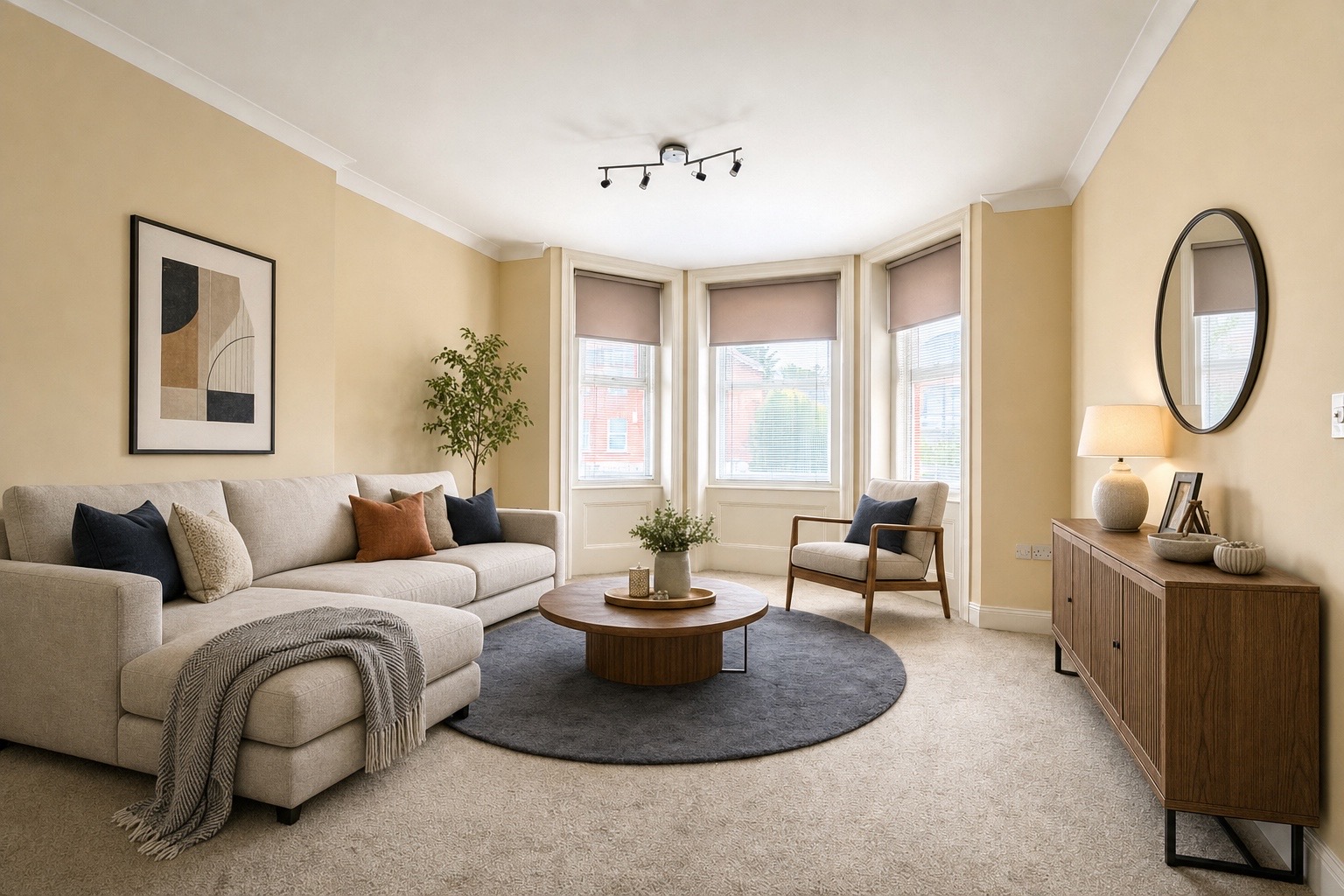
An empty property is notoriously hard to sell. Buyers struggle to visualise scale, layout, and how they'd actually live in a space when it's devoid of furniture. Traditionally, the solution was physical home staging — renting furniture and accessories to dress a property for photography and viewings. It costs £2,000–8,000 and requires access for 2–4 days.
Virtual staging does the same thing digitally — for around £20–80 per room.
What virtual staging actually is
Virtual staging is the process of digitally inserting furniture, décor, and accessories into a photo of an empty room. Done well, the result is photorealistic — indistinguishable from a photo of a physically staged room to most buyers.
The furniture placed is typically contemporary and aspirational — the kind of thing you'd see in a new-build show home. Styles can usually be chosen: Scandi minimalist, contemporary luxury, traditional, and so on.
Key distinction: Virtual staging works on photos of empty rooms. It cannot remove existing furniture from a photo (that's a different and much harder process called "virtual decluttering"). For best results, photograph empty rooms and stage virtually, rather than trying to work with furnished rooms.
What does virtual staging cost?
Prices vary widely depending on quality and turnaround:
- Budget AI tools: £5–15 per room — often inconsistent quality, generic furniture styles
- Professional virtual staging services: £25–80 per room — human designers working with AI, better quality control
- Premium services: £100+ per room — bespoke furniture placement, style consultation, multiple revision rounds
For most UK estate agency purposes, a mid-tier service at £30–50 per room provides results that are more than adequate for Rightmove and Zoopla listings.
Is virtual staging legal for UK property listings?
This is the most important question — and the answer requires some nuance.
Virtual staging is legal in UK property marketing, subject to proper disclosure. The Consumer Protection from Unfair Trading Regulations 2008 (CPRs) require that material information about a property is not omitted or misrepresented. Virtually staged photos, if not disclosed, could constitute misleading commercial practice if buyers were misled about what was physically present in the property.
The correct approach — and the industry standard — is to label virtually staged photos clearly. The caption or photo description should note: "Artist's impression — virtually staged." Most serious property portals now require this labelling when using virtual staging.
Best practices for UK agents using virtual staging
- Always label virtually staged photos as such — in the photo caption or description
- Don't use virtual staging to conceal defects — hide damp, cracks, or structural issues behind virtual furniture. This is clearly deceptive and legally problematic.
- Include one unstaged photo alongside each staged version so buyers can see the actual empty room
- Be consistent — if some photos are staged and some aren't, this is confusing. Stage all rooms or none.
When virtual staging makes most commercial sense
Virtual staging is most valuable for:
- New builds and developer plots — show homes are expensive, virtual staging is fast and cheap
- Probate properties — empty following bereavement; physical staging is impractical
- Investment properties — where the vendor doesn't want to spend on physical staging
- Overseas buyers — who are buying without viewings and need to visualise the property fully
For occupied properties in decent condition, AI enhancement of existing photos (rather than virtual staging) is usually the right choice. Virtual staging adds most value where rooms are genuinely empty.
See it for yourself — free first photo
Upload a phone photo from your last valuation and get it back straightened, brightened and colour-corrected in under 5 minutes. No subscription required to start.
Try ReShot free →